
Hidden Mechanisms of Critical-Metal Enrichment in Deep Tropical Lateritic Weathering Profiles
-
Uguru Chukwudi Clement
Engineering Department, Esut Business School, Nigeria
David Chinonso Anih

Department of Biochemistry, Faculty of Biosciences, Federal University Wukari, Taraba, Nigeria
Adamu Kamaliddeen SalisuGeoscience Department, Faculty of Science, Management & Computing, Univeristi Teknologi Petronas, Malaysia
Nwanze Tobechukwu JosephDepartment of Civil and Environmental Engineering, University of Lagos, Akoka, Lagos State, Nigeria
| Received 03 Nov, 2025 |
Accepted 31 Dec, 2025 |
Published 15 Jan, 2026 |
This review brings together recent field based and laboratory studies (2020 to 2025) that investigate concealed concentrations of critical metals, including rare earth elements (REEs), scandium, nickel and cobalt, within deep tropical lateritic weathering profiles. Using a PRISMA framework, the authors reduced an initial pool of 1,240 records to fifty studies that satisfied strict inclusion criteria for geochemical, isotopic and mineralogical data quality. The aim is to integrate lines of evidence to explain how these metals are mobilized, transported and fixed beneath the visible laterite mantle and to highlight consequences for exploration and environmental management. The selected investigations deployed high sensitivity trace element analysis (ICP MS), neodymium and strontium isotopes measured by multi collector ICP MS, X ray diffraction, scanning electron microscopy with energy dispersive spectroscopy, and sequential leaching experiments to partition operational metal fractions. By comparing depth resolved geochemical profiles, isotopic fingerprints and mineral host relationships, the synthesis distinguishes metals inherited from parent lithology from those redistributed by fluid flow and redox processes. Clear and consistent patterns emerge across diverse tropical settings. Parent rock composition exerts a primary control: Mafic protoliths favor nickel and cobalt enrichment typically hosted by iron oxyhydroxides and manganese phases, while felsic sources more often retain REE and scandium within resistant accessory minerals such as zircon, monazite and anatase. Isotopic gradients, together with sequential leach results, support a working model in which metals are leached from surficial horizons and reprecipitated at depth, forming cryptic enrichment zones commonly between about 10 and 20 m below ground. Seasonal water table shifts, oscillating redox conditions, organic complexation and microbial activity emerge as key modulators of metal mobility. The review demonstrates that reliance on shallow sampling can overlook blind deposits. Integrated exploration strategies that combine deep coring, isotopic mapping, targeted mineralogical screening and sequential leaching enhance discovery success. Equally important, responsible development requires life cycle assessment, circular economy measures and inclusive land use planning to limit deforestation, erosion and water contamination. By synthesizing multiproxy evidence, this study advances a refined conceptual model for hidden lateritic enrichment and offers practical guidance for more effective and environmentally responsible critical metal exploration in tropical regions.
| Copyright © 2026 Clement et al. This is an open-access article distributed under the Creative Commons Attribution License, which permits unrestricted use, distribution, and reproduction in any medium, provided the original work is properly cited. |
INTRODUCTION
The accelerating global shift toward renewable energy and low-carbon technologies has placed unprecedented emphasis on the availability of critical metals such as rare earth elements (REEs), nickel (Ni), cobalt (Co), and scandium (Sc). These elements are indispensable for manufacturing high-performance batteries, permanent magnets, wind turbines, and other strategic components that underpin the green energy transition1. As nations intensify their commitments to decarbonization, the demand for these metals is projected to rise sharply, creating both opportunities and challenges for sustainable resource supply2.
Tropical lateritic weathering systems have emerged as one of the most significant natural repositories of these metals. The intense chemical weathering driven by warm, humid climates leads to the development of thick weathering mantles, where secondary enrichment processes can concentrate valuable elements3. Lateritic nickel and cobalt deposits, for instance, already account for a substantial share of global supply, and recent studies suggest that REEs and Sc may also be enriched in these profiles under specific geochemical conditions4. However, despite their importance, the mechanisms that govern hidden enrichment within deep lateritic horizons remain poorly understood.
One of the central knowledge gaps lies in the recognition of subtle processes such as sub-profile remobilization, where metals are leached from upper horizons and reprecipitated at depth, creating concealed enrichment zones5. Isotopic fractionation has also been identified as a key tracer of these processes, offering insights into fluid pathways and redox conditions that control metal mobility6. Furthermore, mineralogical trapping, where metals are incorporated into secondary phases such as clays, iron oxides, or phosphates, adds another layer of complexity to enrichment dynamics7. These hidden processes often escape detection in conventional exploration models, underscoring the need for integrated geochemical, isotopic, and mineralogical approaches.
The objective of this study is to synthesize the most recent evidence on critical-metal enrichment in deep tropical lateritic profiles, with a focus on unveiling the hidden mechanisms that drive their formation. By bridging insights from geochemistry, isotope systematics, and mineralogy, this work aims to refine our understanding of lateritic enrichment processes and highlight their implications for sustainable resource development in the context of the global energy transition.
MATERIALS AND METHODS
The methodological framework for this study was designed to ensure a comprehensive and unbiased synthesis of the most current knowledge on hidden critical-metal enrichment in tropical lateritic weathering profiles. A systematic search was carried out across four major scientific databases: Web of Science, Scopus, GeoRef, and ScienceDirect, because of their extensive coverage of geoscience, geochemistry, and mineralogical research. The search terms were carefully selected to capture the complexity of the subject, including “lateritic weathering,” “critical metals,” “REE enrichment,” “tropical profiles,” “Nd-Sr isotopes,” and “hidden enrichment.” Boolean operators were applied to refine the search and maximize the retrieval of relevant studies. The timeframe was set between 2020 and 2025, ensuring that only the most recent and relevant works were included, reflecting the latest advances in geochemical and mineralogical approaches8.
Inclusion criteria were established to prioritize peer-reviewed studies that provided robust field-based geochemical analyses, isotopic investigations, and mineralogical characterizations. Eligible studies were required to present original data on lateritic weathering in tropical environments, focus on critical metals such as REEs, Ni, Co, and Sc, employ advanced analytical methods such as ICP-MS, isotopic tracing, XRD, SEM, or sequential leaching, and provide sufficient methodological detail for reproducibility. Exclusion criteria eliminated studies that were not peer-reviewed, lacked methodological clarity, or focused on non-tropical systems. This rigorous filtering process ensured that the final dataset reflected only high-quality, reproducible science9.
|
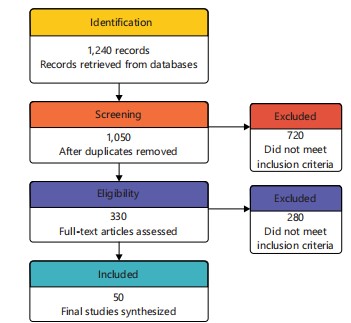
The study selection process followed the Preferred Reporting Items for Systematic Reviews and Meta-Analyses (PRISMA) framework. The initial search retrieved 1,240 records. After removing duplicates, 1,050 unique records remained. Title and abstract screening excluded 720 irrelevant studies. Full-text screening of 330 papers led to the exclusion of 280 due to insufficient methodological detail or lack of focus on critical metals. Ultimately, 50 studies were included in the final synthesis10.
Figure 1 illustrates the PRISMA-based workflow described in Section 2, showing how 1,240 records retrieved from databases were progressively screened to yield 50 eligible studies. It captures each stage of the review process from identification and duplicate removal to full-text assessment and exclusion. The diagram provides a transparent overview of how the final synthesis dataset was derived.
The analytical methods employed in the selected studies were diverse but complementary, allowing for a holistic understanding of hidden enrichment mechanisms. Inductively Coupled Plasma Mass Spectrometry (ICP-MS) was the primary tool for quantifying trace elements and REEs. Its high sensitivity and precision make it particularly suitable for detecting low-abundance critical metals, and recent advances in interference reduction have further improved accuracy11. Calibration was performed using certified reference materials, and quality control was maintained through repeated analysis of standards and blanks.
The Nd and Sr isotopic tracing was employed to unravel the influence of parent rocks and fluid-rock interactions on lateritic profiles. The Nd isotopes provide insights into the provenance of REEs, while Sr isotopes are sensitive to remobilization pathways. Together, they help reveal the hidden processes of metal redistribution within deep weathering horizons. High-precision isotopic ratios were obtained using multi-collector ICP-MS, with mass bias corrections applied through standard-sample bracketing12.
Mineralogical characterization was achieved through X-Ray Diffraction (XRD) and Scanning Electron Microscopy (SEM). XRD identified crystalline mineral phases, while SEM provided high-resolution imaging of mineral textures and microstructures. These techniques were crucial for detecting mineralogical traps that host critical metals, such as clays, iron oxides, and secondary phosphates. The SEM-EDS mapping further allowed for semi-quantitative elemental analysis, revealing the spatial distribution of metals within mineral matrices.
Sequential leaching experiments were conducted to partition metals into operationally defined fractions, including exchangeable, carbonate-bound, oxide-bound, and residual phases. This method provided insights into the mobility and bioavailability of critical metals under varying geochemical conditions. By simulating natural weathering processes, sequential leaching helped identify hidden enrichment zones that may not be apparent from bulk geochemical analyses alone.
The integration of these methods provided a robust framework for data synthesis. Geochemical data from ICP-MS were cross-referenced with isotopic signatures to establish links between parent rock composition and enrichment patterns. Mineralogical data from XRD and SEM contextualized geochemical findings, while sequential leaching experiments offered a dynamic perspective on metal mobility. This holistic approach allowed for a nuanced understanding of hidden enrichment mechanisms in tropical lateritic systems, highlighting the interplay between geochemistry, isotopic systematics, and mineralogical controls13.
RESULTS AND DISCUSSION
Geochemical signatures of lateritic profiles: Lateritic profiles across tropical regions consistently reveal strong chemical differentiation between upper and lower horizons. Major element distributions show progressive depletion of mobile elements such as Ca, Na, and K, while immobile elements like Al, Fe, and Ti become enriched. Trace element analysis highlights the selective retention of critical metals, with REEs showing distinct fractionation patterns. Light rare earth elements (LREEs) are often preferentially mobilized under acidic leaching conditions, whereas heavy rare earth elements (HREEs) tend to remain bound to resistant mineral phases or secondary oxide.
Comparative studies from the Amazon, West Africa, and India demonstrate that REE fractionation is not uniform but depends on local hydrology and mineralogy. In Amazonian laterites, Ce anomalies are common due to oxidative scavenging, while in West African profiles, Nd and Sm enrichment is linked to clay-rich horizons. Indian laterites, particularly those derived from charnockites, show strong HREE retention in association with zircon and anatase, underscoring the role of resistant minerals in shaping geochemical signatures.
Table 1 is a representative geochemical profile. One-line summary comparing major element trends and REE fractionation patterns for Amazon, West Africa, and India.
Parent rock and mineralogical controls: The composition of the parent rock exerts a profound influence on lateritic enrichment. Mafic protoliths, rich in ferromagnesian minerals, tend to yield higher Ni and Co concentrations, while felsic protoliths favor REE and Sc accumulation. Resistant accessory minerals such as zircon, monazite, and anatase act as long-term hosts for REEs, buffering against complete leaching.
Recent mineralogical studies reveal that anatase not only retains Ti but also incorporates trace amounts of Nb and HREEs, making it a critical phase in felsic-derived laterites.
Table 2 illustrates parent rock types versus dominant metal enrichment and key mineral hosts. One-line comparison of mafic, felsic, and intermediate protoliths and the metals and mineral hosts they typically produce.
| Table 1: | Representative geochemical profiles from Amazon, West Africa, and India | |||
| Region | Major element trends | REE fractionation | Citation(s) |
| Amazon | Depletion of Ca, Na, Fe-Al enrichment | Positive Ce anomaly | Paskarino et al.14 |
| West Africa | Strong Al-Fe buildup | Nd, Sm enrichment in clays | Denys et al.15 |
| India | Ti-Fe enrichment | HREE retention in zircon/anatase | Freitas et al.16 |
| Reports region, major element trends (for example depletion of Ca and Na; Fe and Al enrichment), typical REE fractionation (Ce anomalies, Nd/Sm patterns), and short interpretive notes, REE: Rare earth element, LREE: Light rare earth elements, HREE: Heavy rare earth elements, Ce: Cerium, Nd: Neodymium, Sm: Samarium, Ca: Calcium, Na: Sodium, Fe: Iron and Al: Aluminum | |||
| Table 2: | Parent-rock types vs. enrichment factors | |||
| Parent rock | Dominant metals enriched | Key mineral hosts | Citation(s) |
| Mafic (basalt, gabbro) | Ni, Co | Goethite, Mn-oxides | Liang et al.17 |
| Felsic (granite, charnockite) | REEs, Sc | Zircon, monazite, anatase | Guo et al.18 |
| Intermediate (andesite) | Mixed REE-Ni | Clay minerals, ilmenite | Oyebamiji et al.19 |
| Lists Parent rock, Dominant metals enriched, and Key mineral hosts, examples include mafic→nickel and cobalt hosted by goethite and manganese oxides, felsic-rare earth elements and scandium hosted by zircon, monazite, and anatase, Ni: Nickel, Co: Cobalt, REEs: Rare earth elements, Sc: Scandium, Mn: Manganese and Fe: Iron | |||
| Table 3: | Isotopic ratios across depth profiles | |||
| Region | Nd isotopic signature | Sr isotopic signature | Citation(s) |
| West Africa | Parent-rock consistent | Evidence of deep remobilization | Qian et al.20 |
| Amazon | Variable, fluid-influenced | Disequilibria across horizons | Putzolu et al.21 |
| India | Stable Nd ratios | Sr shifts with hydrology | Rasool et al.22 |
| Reports region-by-region Nd and Sr signatures observed in depth profiles and brief interpretive notes on source versus mobilization, Nd: Neodymium, Sr: Strontium and REE: Rare earth element | |||
Isotopic tracers of hidden enrichment: The Nd-Sr isotopes provide fingerprints of metal sources and remobilization pathways. Nd isotopic ratios often reflect the original parent rock, while Sr isotopes are more sensitive to fluid-rock interactions. Depth profiles from West African laterites show isotopic evidence of REE leaching from upper horizons and reprecipitation at depth, forming cryptic enrichment zones.
In Amazonian profiles, isotopic disequilibria between Nd and Sr suggest multiple fluid pulses, highlighting the dynamic nature of hidden enrichment.
Table 3 explains Nd and Sr isotopic signatures across depth profiles by region. Short regional comparison indicating whether Nd reflects parent rock and whether Sr shows fluid-driven remobilization.
Hydrological and redox mechanisms: Hydrological fluctuations, particularly seasonal water table changes, strongly influence metal mobility. During wet seasons, downward percolation mobilizes REEs, Ni, and Co, while dry seasons promote re-precipitation. Fe-oxyhydroxides and Mn-oxides act as scavengers, capturing metals and creating redox-sensitive enrichment zones.
Field studies in Central Africa show that alternating oxidizing and reducing conditions drive cyclic enrichment of Co and Ni, while REEs are selectively retained in Fe-rich nodules.
Table 4 shows the redox-sensitive element behavior and typical host phases. Quick summary of element redox responses (for example, Co and Ni mobilized under reducing conditions) and their common mineral hosts.
Organic matter and microbial mediation: Organic matter plays a subtle but important role in REE mobility. Organic ligands such as humic and fulvic acids enhance REE solubility, particularly for LREEs. Microbial activity further contributes by producing organic acids that bio-weather minerals, releasing metals into solution.
| Table 4: | Redox-sensitive element distributions | |||
| Element | Redox behavior | Host phase | Citation(s) |
| Co, Ni | Mobilized under reducing conditions | Reprecipitated in Fe-oxides | Bollaert et al.23 |
| REEs | Retained under oxidizing conditions | Fe-Mn nodules | Ren et al.24 |
| Ce | Forms positive anomalies | CeO2 in oxic zones | Shankar et al.25 |
| Tabulates elements, their redox behavior, and typical host phases (for example, Co and Ni mobilized under reducing conditions and reprecipitated in iron oxides), Co: Cobalt; Ni: Nickel, REEs: Rare earth elements, Ce: Cerium, Fe: Iron, Mn: Manganese and CeO2: Cerium dioxide | |||
| Table 5: | Organic matter content vs. REE mobility | |||
| Horizon | Organic matter (%) | REE mobility | Citation(s) |
| Surface | High | Enhanced LREE solubility | Dybowska et al.26 |
| Mid-depth | Moderate | Microbial complexation | Cao et al.27 |
| Deep | Low | Limited mobility | Wen et al.28 |
| Displays horizons, percent organic matter where given, and the observed REE mobility pattern (surface: enhanced LREE solubility, mid-depth: Microbial complexation, deep: Limited mobility), REE: Rare earth element and LREE: Light rare earth elements | |||
| Table 6: | Depth-resolved enrichment factors | |||
| Depth (m) | Enrichment factor | Dominant metals | Citation(s) |
| 0-5 | Low | Fe, Al | Dong et al.29 |
| Oct-15 | High | REEs, Sc | Zhao et al.30 |
| 20+ | Moderate | Ni, Co | Sababa et al.31 |
| Shows depth intervals in meters, enrichment factor category (low/moderate/high), and dominant metals at each depth to highlight cryptic enrichment zones, m: Meters, REEs: Rare earth elements, Sc: Scandium, Ni: Nickel and Co: Cobalt | |||
Recent studies in Amazonian laterites show that microbial biofilms can concentrate REEs by complexation, creating micro-enrichment zones.
Table 5 is the organic matter content by horizon and associated REE mobility. Brief horizon-by-horizon note that surface organic-rich horizons enhance LREE solubility while deep horizons show limited mobility.
Hidden enrichment in subsurface horizons: Evidence from Amazonia and Central Africa reveals cryptic enrichment zones below the visible laterite crust. These zones often occur at depths of 10-20 m, where metals leached from upper horizons re-precipitate.
Geochemical modeling suggests that these hidden zones may contain economically significant concentrations of REEs and Sc, even when surface samples appear depleted. Case studies highlight the importance of deep drilling in exploration strategies.
Table 6 is a depth-resolved enrichment factor and dominant metals by depth interval. Single-line mapping of enrichment (low/moderate/high) to depth intervals (0-5, 10-15, 20+ m) and dominant metals at each depth.
Implications for resource exploration: The recognition of hidden enrichment zones has major implications for exploration. Traditional surface sampling may underestimate resource potential, necessitating integration of isotopic and mineralogical proxies.
Exploration strategies now emphasize combining geochemical surveys with isotopic mapping and mineralogical analysis to identify blind enrichment zones. This integrated approach reduces exploration risk and improves targeting efficiency.
Table 7 illustrates key exploration indicators for detecting hidden enrichment and their application. One-line summary pairing indicators like Nd-Sr isotopes, resistant minerals, and sequential leaching with their practical uses.
| Table 7: | Exploration indicators for hidden enrichment | |||
| Indicator | Application | Citation(s) |
| Nd-Sr isotopes | Fingerprinting hidden sources | Roy et al.32 |
| Resistant minerals | Tracing REE retention | Hutchinson et al.33 |
| Sequential leaching | Identifying cryptic mobility | Zhou et al.34 |
| Pairs each exploration indicator with a short statement of application (for example Nd-Sr isotopes = Fingerprinting hidden sources, Resistant minerals: Tracing REE retention), Abbreviations: Nd: Neodymium, Sr: Strontium and REE: Rare earth element | ||
| Table 8: | Environmental trade-offs of laterite exploitation | |||
| Strategy | Benefit | Risk | Citation(s) |
| Direct mining | Immediate resource supply | Ecosystem disruption | Ratié et al.35 |
| Recycling | Reduces mining pressure | Limited scalability | Jose et al.36 |
| Circular economy | Long-term sustainability | Requires policy support | Barakos et al.37 |
| List strategy options with concise statements of primary benefit and main ecological or policy risk for each; no abbreviations used in this table | |||
Environmental and sustainability considerations: While lateritic profiles hold promise for critical-metal supply, extraction poses risks to fragile tropical ecosystems. Mining can lead to deforestation, soil erosion, and contamination of water systems.
Sustainability frameworks emphasize balancing extraction with circular economy approaches, such as recycling and substitution. Recent studies argue that integrating life-cycle assessments into exploration and mining planning is essential to minimize ecological footprints.
Table 8 is an environmental tradeoff of alternative approaches to laterite resource use. Short comparison of direct mining, recycling, and circular economy approaches with primary benefits and main ecological or policy risks.
CONCLUSION
Deep tropical lateritic profiles commonly hide economically important concentrations of REEs, Sc, Ni, and Co beneath the surface, shaped by parent rock, redox dynamics, hydrology, and resistant minerals. Shallow sampling alone risks overlooking these blind zones, so exploration must move beyond surface ASSAYS. Combining deep coring with isotopic mapping, targeted mineralogy, and sequential leaching offers the best chance to locate subsurface enrichments. Environmental safeguards are essential; life cycle assessment, recycling strategies, and careful land use planning should accompany any field program. Future work should probe the role of organic ligands and microbes in mobilizing and concentrating light rare earth elements at microscales. Seasonally resolved isotopic and hydrological studies will sharpen our understanding of when and where metals migrate and precipitate. Laboratory experiments that quantify trace element partitioning into accessory phases like anatase, zircon, and monazite will improve host-phase models. There is a clear need for integrated predictive tools that fuse geochemistry, mineralogy, and geostatistics, ideally using machine learning to target drilling. Socioeconomic and governance research must run in parallel so that exploration benefits are shared and ecological impacts minimized. Taken together, these steps will help reconcile critical metal supply needs with responsible stewardship of tropical landscapes.
SIGNIFICANCE STATEMENT
This study reveals that deep tropical lateritic profiles harbor hidden zones of critical metal enrichment shaped by geochemical, isotopic, and mineralogical interactions. By integrating multi-analytical evidence from recent global studies, it uncovers how leaching, redox cycling, and mineral trapping control the subsurface distribution of rare earth elements, scandium, nickel, and cobalt. These insights provide a scientific foundation for more accurate exploration strategies and sustainable management of critical metal resources in tropical regions.
ACKNOWLEDGMENT
We sincerely thank the authors of the primary studies reviewed and the colleagues who provided valuable insights during the preparation of this systematic review. We are also grateful to the anonymous reviewers whose constructive comments helped improve the clarity and quality of the manuscript. Finally, we deeply appreciate our families for their patience, understanding, and encouragement throughout this work.
REFERENCES
- Yao, W., C. Tian, Y. Teng, F. Diao, X. Du, P. Gu and W. Zhou, 2025. Development of deep-sea mining and its environmental impacts: A review. Front. Mar. Sci., 12.
- Jiang, S.Y., W. Wang and H.M. Su, 2023. Super-enrichment mechanisms of strategic critical metal deposits: Current understanding and future perspectives. J. Earth Sci., 34: 1295-1298.
- Cugerone, A. and B. Cenki, 2025. Evaluating the role of ore metamorphism and deformation in the remobilization of critical metals during orogens formation. Ore Geol. Rev., 186.
- Laita, E., B. Bauluz and A. Yuste, 2024. The role of clay minerals in the concentration and distribution of critical metals in lateritic palaeosols from NE Iberia. Appl. Clay Sci., 249.
- Horbe, A.M.C., M.F. dos Santos Albuquerque and E.L. Dantas, 2022. Nd and Sr isotopes and REE investigation in tropical weathering profiles of Amazon region. Front. Earth Sci., 10.
- Delina, R.E.G., J.P.H. Perez, J.A. Stammeier, E.F. Bazarkina and L.G. Benning, 2024. Partitioning and mobility of chromium in iron-rich laterites from an optimized sequential extraction procedure. Environ. Sci. Technol., 58: 6391-6401.
- Rezaei, M., G. Sanchez-Lecuona and O. Abdolazimi, 2025. A cross-disciplinary review of rare earth elements: Deposit types, mineralogy, machine learning, environmental impact, and recycling. Minerals, 15.
- Ciazela, J., M. Junge, H.M. Helmy, L. Chen and O. Nadeau, 2024. Editorial: Ore formation and critical metal deposits: Geological contribution to the clean energy transition. Front. Earth Sci., 12.
- Ren, J., X. Jiang, F.J. González and Y. Dong, 2025. Editorial: Biogeochemical cycling and depositional processes of critical metals in the deep sea and their constraints on global changes. Front. Mar. Sci., 12.
- Kunz, B.E., C.J. Warren, F.E. Jenner, N.B.W. Harris and T.W. Argles, 2022. Critical metal enrichment in crustal melts: The role of metamorphic mica. Geology, 50: 1219-1223.
- Economou-Eliopoulos, M., M. Laskou, D. Eliopoulos, I. Megremi, S. Kalatha and G. Eliopoulos, 2021. Origin of critical metals in Fe-Ni laterites from the balkan peninsula: Opportunities and environmental risk. Minerals, 11.
- Lu, X., J. Bai, F. Ye and G. Wei, 2024. Progress and prospect of rare earth elements stable isotope analysis techniques. J. Earth Sci., 35: 2129-2132.
- Zhao, X., S. Tang, J. Li, H. Wang and R. Helz et al., 2020. Titanium isotopic fractionation during magmatic differentiation. Contrib. Mineral. Petrol., 175.
- Paskarino, Y.H., G.Y. Putra, Sutarto, J. Soesilo and B. Sutopo, 2025. Scandium enrichment in the Mandiodo nickel laterite, North Konawe, Southeast Sulawesi. Int. J. Innovative Res. Sci. Stud., 8: 1317-1332.
- Denys, A., E. Janots, A.L. Auzende, M. Lanson, N. Findling and N. Trcera, 2020. Evaluation of selectivity of sequential extraction procedure applied to REE speciation in laterite. Chem. Geol., 559.
- Freitas, C.A., A.M.C. Horbe, M.F. dos Santos Albuquerque and R.T. Castro, 2024. Unraveling parent rock and mineral influences in tropical weathering profiles: REE, Nd and Sr isotopic geochemistry. Minerals, 14.
- Liang, B., G. Han, J. Zeng, R. Qu, M. Liu and J. Liu, 2021. Geochemistry and environmental effects of rare-earth elements in laterites from Yunnan Province, SW China. Geochem.: Explor. Environ. Anal., 21.
- Guo, W., Z. Zhao, C. Wang, D. Wang and X. Chen et al., 2024. Micro-topographic controls on rare earth element accumulation and fractionation in weathering profiles: Case study of ion-adsorption rare earth element deposit in Hedi, Zhejiang Province, China. Minerals, 14.
- Oyebamiji, A.O., O.A. OlaOlorun, T. Zafar, Y.A. Abdu-Raheem, O.J. Popoola, M.A. Oguntuase and S.M. Hassan, 2025. Geochemical characteristics, distribution and provenance of rare earth elements (REEs) in soil profiles of Jebba Area, North Central Nigeria-insights from the controls on the interplay of REEs in soils. Soil Sediment Contam.: Int. J..
- Qian, L., L. Ou, G. Li, X. Xiao and B. Qian, 2025. Fractionation mechanisms of rare earth element speciation in granitic weathering profiles: Metallogenic implications for the kuanyu ion-adsorption REE deposit, dechang, SW China. PLoS ONE, 20.
- Putzolu, F., L. Santoro, C. Porto, N. Mondillo and M. Machado et al., 2021. The influence of the magmatic to postmagmatic evolution of the parent rock on the co deportment in lateritic systems: The example of the Santa Fé Ni-Co Deposit (Brazil). Econ. Geol., 116: 837-861.
- Rasool, M.H., S. Ridha, M. Ahmad, R.A.B. Shamsuddun, M.K. Zahoor and A. Khan, 2025. A mineralogical perspective on rare earth elements (REEs) extraction from drill cuttings: A review. Minerals, 15.
- Bollaert, Q., M. Chassé, A.B. Neto, B. Baptiste, A. Courtin et al., 2023. Mechanisms leading to exceptional niobium concentration during lateritic weathering: The key role of secondary oxides. Chem. Geol., 641.
- Ren, J., A. Gu, K. Sun, H. Zhang and J. Li et al., 2025. A review of rare earth elements resources in Africa. Minerals, 15.
- Shankar, R., D.S. Sarma, A. Panda, A.G. Panicker and S. Augustine, 2024. Determining high-precision Sr-Nd isotopic ratios of certified reference materials using thermal ionization mass spectrometry. J. Anal. At. Spectrom., 39: 2129-2138.
- Dybowska, A., P.F. Schofield, L. Newsome, R.J. Herrington and J.F.W. Mosselmans et al., 2022. Evolution of the Piauí laterite, Brazil: Mineralogical, geochemical and geomicrobiological mechanisms for cobalt and nickel enrichment. Minerals, 12.
- Cao, C., X.M. Liu and J. Chen, 2022. Cerium anomaly as a tracer for paleo-oceanic redox conditions: A thermodynamics-based Ce oxidation modeling approach. Front. Earth Sci., 10.
- Wen, Y., P. Liu, Q. Wang, S. Zhao and Y. Tang, 2024. Organic ligand-mediated dissolution and fractionation of rare-earth elements (REEs) from carbonate and phosphate minerals. ACS Earth Space Chem., 8: 1048-1061.
- Dong, W., Y. Song, L. Wang, W. Jian and Q. Zhou, 2025. Phyto- and microbial-based remediation of rare-earth-element-polluted soil. Microorganisms, 13.
- Zhao, A., J. Sun and Y. Liu, 2023. Understanding bacterial biofilms: From definition to treatment strategies. Front. Cell. Infect. Microbiol., 13.
- Sababa, E., L.G.E. Owona, J.P. Temga and P.D. Ndjigui, 2021. Petrology of weathering materials developed on granites in Biou Area, North-Cameroon: Implication for rare-earth elements (REE) exploration in semi-arid regions. Heliyon, 7.
- Roy, S., S.S. Acharya and R. Chakrabarti, 2024. Mobilization of rare earth elements during extreme weathering of basalt. Geochemistry, 84.
- Hutchinson, M., P. Slezak, R. Wendlandt and M. Hitzman, 2022. Rare earth element enrichment in the weathering profile of the Bull Hill carbonatite at Bear Lodge, Wyoming, USA. Econ. Geol., 117: 813-831.
- Zhou, Y., T. Wang, F. Fan, S. Chen and W. Guo et al., 2022. Advances on exploration indicators of mineral VNIR-SWIR spectroscopy and chemistry: A review. Minerals, 12.
- Ratié, G., J. Garnier, L.C. Vieira, D.F. Araújo, M. Komárek, F. Poitrasson and C. Quantin, 2021. Investigation of Fe isotope systematics for the complete sequence of natural and metallurgical processes of Ni lateritic ores: Implications for environmental source tracing. Appl. Geochem., 127.
- Jose, S.A., J. Calhoun, O.B. Renteria, P. Mercado and S. Nakajima et al., 2024. Promoting a circular economy in mining practices. Sustainability, 16.
- Barakos, G., 2022. Sustainable mining of critical minerals and metals around the world: Bottlenecks and opportunities. Int. J. Min. Reclam. Environ., 36: 605-606.
How to Cite this paper?
APA-7 Style
Clement, U. C., Anih, D. C., Salisu, A. K., & Joseph, N. T. (2026). Hidden mechanisms of critical-metal enrichment in deep tropical lateritic weathering profiles. Asian Journal of Earth Sciences, 19(1), 1–10. https://doi.org/10.3923/ajes.2026.01.10
ACS Style
Clement, U. C.; Anih, D. C.; Salisu, A. K.; Joseph, N. T. Hidden Mechanisms of Critical-Metal Enrichment in Deep Tropical Lateritic Weathering Profiles. Asian J. Earth Sci 2026, 19 (1), 1–10. https://doi.org/10.3923/ajes.2026.01.10
AMA Style
Clement UC, Anih DC, Salisu AK, Joseph NT. Hidden mechanisms of critical-metal enrichment in deep tropical lateritic weathering profiles. Asian Journal of Earth Sciences. 2026;19(1):1–10. doi:10.3923/ajes.2026.01.10
Chicago/Turabian Style
Clement, Uguru Chukwudi, David Chinonso Anih, Adamu Kamaliddeen Salisu, and Nwanze Tobechukwu Joseph. 2026. “Hidden Mechanisms of Critical-Metal Enrichment in Deep Tropical Lateritic Weathering Profiles.” Asian Journal of Earth Sciences 19 (1): 1–10. https://doi.org/10.3923/ajes.2026.01.10

This work is licensed under a Creative Commons Attribution 4.0 International License.

